Many people believe that to achieve massive success, they must outwork the entire world.

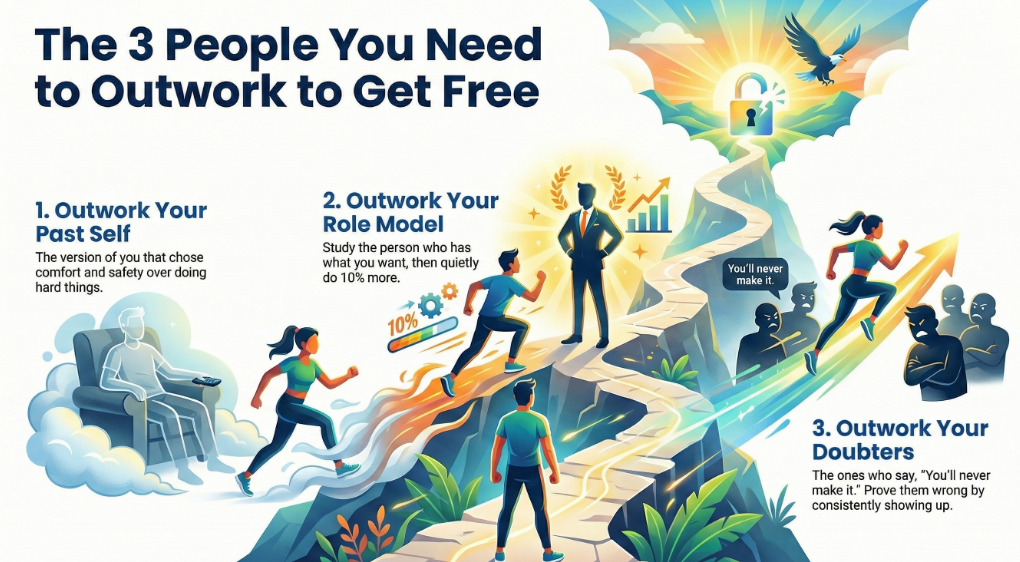
However, you don’t actually need to beat billions of people; you only need to outwork three specific individuals to get ahead of life, to get rich and, more importantly, to get free.
1. The “Past You”

The “Past You” is the version of yourself that prioritized comfort and safety over success. This is the person who looked at a difficult task and decided to do it “later” or stayed in bed because it was warm.

Real-World Example: Imagine a budding entrepreneur who, for months, avoided the “hard thing” – like cold-calling potential clients or waking up at 5:00 AM to work on their business plan before their day job. To win, they must outwork that past version of themselves by doing those exact difficult tasks today that they put off yesterday.

2. The Person Who Already Has What You Want

Instead of falling into the trap of envy, you should study those who have already achieved your goals. Observe how they think, what they sacrificed to get there, and how they execute their daily tasks.

Real-World Example: If you are a salesperson aiming to be the top earner in your firm, don’t just watch the current leader with jealousy. Study their routine and then quietly do 10% more. If they make 50 calls a day, you make 55. If they stay until 6:00 PM, you stay until 6:30 PM. Doing one more call, one more rep, or one more late night is the key to eventually surpassing them.

3. The Person Counting on You to Quit

There will always be skeptics – the people who tell you that your idea is “too risky” or that you “aren’t built for this”. You don’t need to waste your energy arguing with them or trying to prove them wrong with words.

Real-World Example: Think of an athlete whose peers say they’ll never make the varsity team. The athlete doesn’t need to explain their talent; they simply need to keep showing up to every practice and putting in the work until their results become so undeniable that they can no longer be ignored.

The Path to Freedom

If you focus on outworking these three people long enough, you won’t just find get ahead of all those 99% people, you will achieve true freedom.

Success in this journey is like building a stone wall. You aren’t trying to build the whole wall in a day; you are simply focused on laying the next brick better than you did yesterday (outworking “Past You”), laying one more brick than the master mason next to you (outworking the person who has what you want), and continuing to lay bricks even when people say the wall will fall (outworking those counting on you to quit). Eventually, you have a fortress that no one can take away from you.

How to be the Top 1% Learner?

In an age where AI makes intelligence a commodity, your only real competitive edge is how fast you can learn and stay ahead. Most people fail because they try to “jam and cram” information into their prefrontal cortex, which acts like a “tiny cognitive bowl” that can only hold about four independent ideas at once.

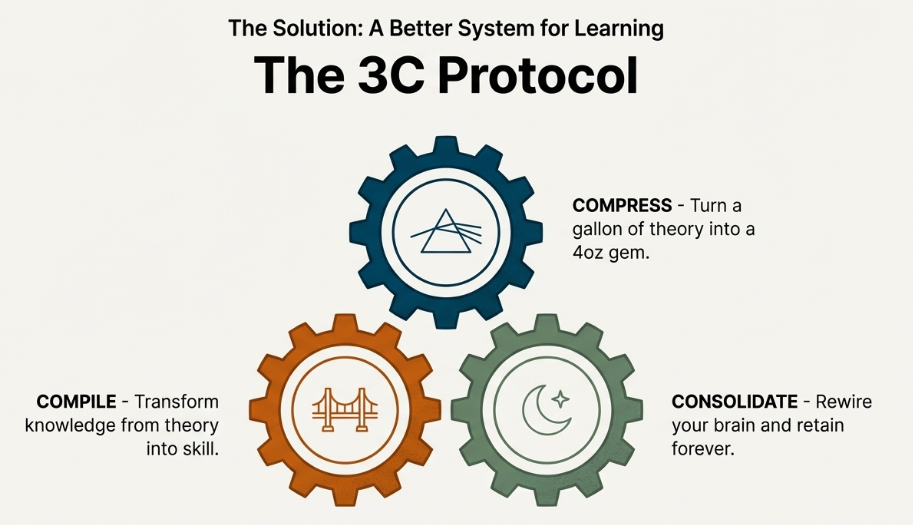
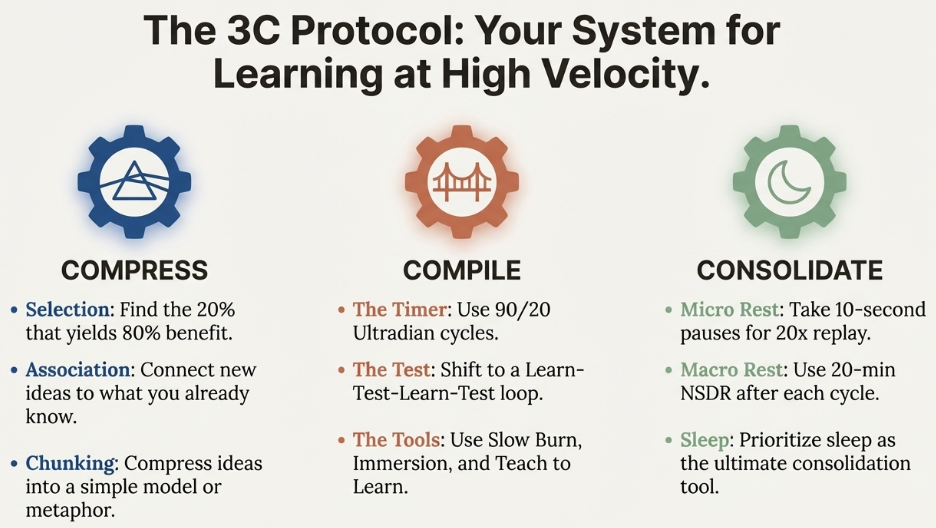
To break into the top 1% of learners, you must stop hoarding information and start using the 3C Protocol: Compress, Compile, and Consolidate.

1. Compress: Turn Data into Patterns

The first step is reducing complex theories into small, manageable chunks that your brain can actually carry.

An Example (Chess): Grandmaster Magnus Carlson doesn’t memorize every possible move; instead, he has internalized up to 100,000 patterns. He wins by associating a new move on the board with an old pattern he already understands.

Actionable Tip: When reading a book, don’t read every page. Apply the 80/20 rule by selecting the 20% of chapters that provide 80% of the value. Connect these new ideas to something you already know and turn them into a simple drawing or metaphor.

2. Compile: Move from Consumption to Action

Mastery is not about what you can recall, but what you can do. The tragic story of savant Kim Peak – who could recall 12,000 books but struggled with basic daily chores – proves that memory alone is not mastery.

An Example (The Musician): If you are learning a physical skill like the guitar, use the “Slow Burn” tool. Play at an excruciatingly slow pace while maintaining intense focus on every micro-move. This ensures the brain is actively “compiling” the skill rather than operating on autopilot.

Actionable Tip: Use 90-minute “ultradian” focus blocks. Instead of waiting months for a final exam, create “agile” learning loops: learn, test, learn, test. You can even “teach to learn” by lecturing to a wall as if you were giving a TED talk to internalize the material.

3. Consolidate: Honor the Rest

Retention doesn’t happen while you are studying; it happens when you stop. Learning is a two-stage process where focus sends the “rewire” request, but rest is where the actual wiring occurs.

An Example (Farmer): Just as a farmer knows a field must rest to regain its fertility, a learner must manage rest at micro and macro levels.

Actionable Tip: Within your 90-minute work block, take 10-second micro-breaks. Research shows that during these pauses, your brain replays what you just learned at 10 to 20 times the speed, giving you “free reps” of practice. After your session, practice NSDR (non-sleep deep rest) or Yoga for 20 minutes to let your brain connect information without distractions.

The Mindset Shift

To succeed with the 3C Protocol, you must stop racing others and focus only on beating who you were yesterday. When you are in the middle of a learning session, be the performer, not the critic. If you feel friction, don’t quit – that struggle is the “generation effect” signaling that deep wiring is taking place.