In an age where AI makes intelligence a commodity, your only real competitive edge is how fast you can learn and stay ahead. Most people fail because they try to “jam and cram” information into their prefrontal cortex, which acts like a “tiny cognitive bowl” that can only hold about four independent ideas at once.
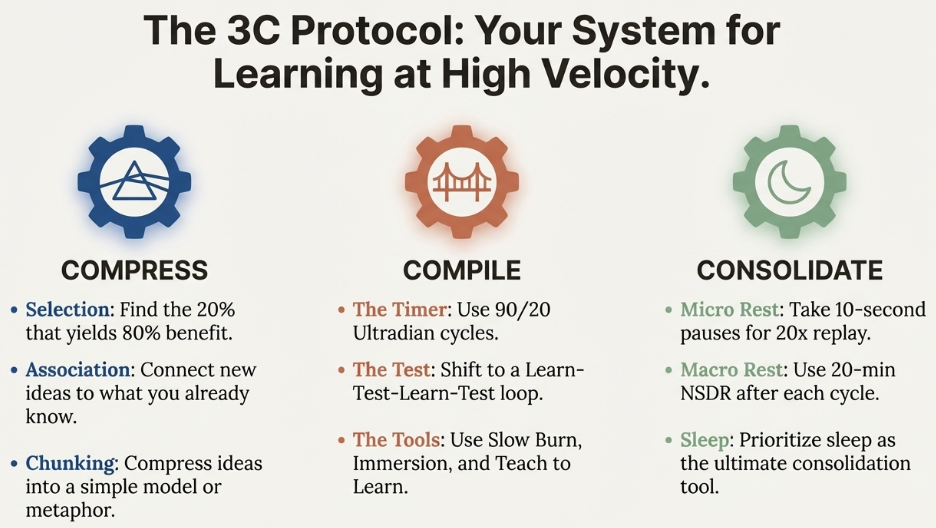
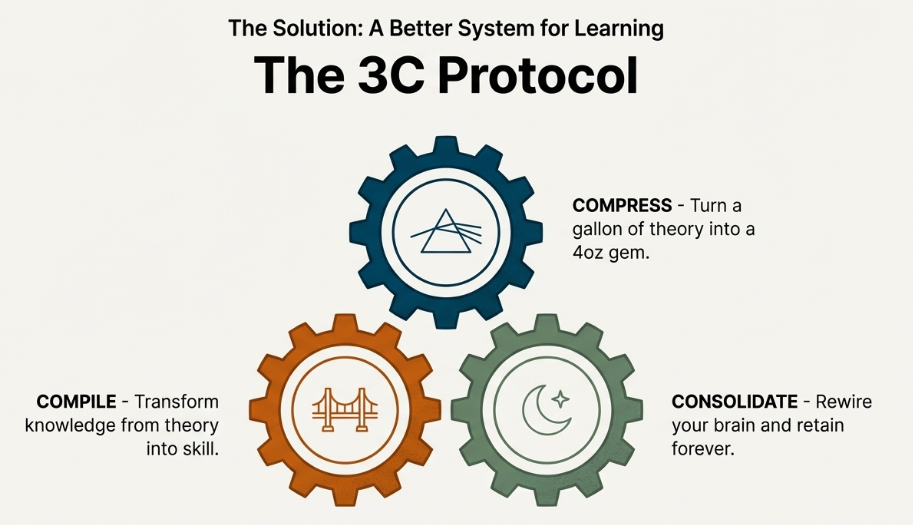
To break into the top 1% of learners, you must stop hoarding information and start using the 3C Protocol: Compress, Compile, and Consolidate.
1. Compress: Turn Data into Patterns
The first step is reducing complex theories into small, manageable chunks that your brain can actually carry.
• An Example (Chess): Grandmaster Magnus Carlson doesn’t memorize every possible move; instead, he has internalized up to 100,000 patterns. He wins by associating a new move on the board with an old pattern he already understands.
• Actionable Tip: When reading a book, don’t read every page. Apply the 80/20 rule by selecting the 20% of chapters that provide 80% of the value. Connect these new ideas to something you already know and turn them into a simple drawing or metaphor.
2. Compile: Move from Consumption to Action
Mastery is not about what you can recall, but what you can do. The tragic story of savant Kim Peak – who could recall 12,000 books but struggled with basic daily chores – proves that memory alone is not mastery.
• An Example (The Musician): If you are learning a physical skill like the guitar, use the “Slow Burn” tool. Play at an excruciatingly slow pace while maintaining intense focus on every micro-move. This ensures the brain is actively “compiling” the skill rather than operating on autopilot.
• Actionable Tip: Use 90-minute “ultradian” focus blocks. Instead of waiting months for a final exam, create “agile” learning loops: learn, test, learn, test. You can even “teach to learn” by lecturing to a wall as if you were giving a TED talk to internalize the material.
3. Consolidate: Honor the Rest
Retention doesn’t happen while you are studying; it happens when you stop. Learning is a two-stage process where focus sends the “rewire” request, but rest is where the actual wiring occurs.
• An Example (Farmer): Just as a farmer knows a field must rest to regain its fertility, a learner must manage rest at micro and macro levels.
• Actionable Tip: Within your 90-minute work block, take 10-second micro-breaks. Research shows that during these pauses, your brain replays what you just learned at 10 to 20 times the speed, giving you “free reps” of practice. After your session, practice NSDR (non-sleep deep rest) or Yoga for 20 minutes to let your brain connect information without distractions.
The Mindset Shift
To succeed with the 3C Protocol, you must stop racing others and focus only on beating who you were yesterday. When you are in the middle of a learning session, be the performer, not the critic. If you feel friction, don’t quit – that struggle is the “generation effect” signaling that deep wiring is taking place.