AI Generalist vs Specialist: Who Wins in the Age of AI?

The world of work is undergoing a profound transformation. For decades, the traditional wisdom was clear: specialists build deep expertise, and generalists provide broad context.

Specialists earned higher pay, commanded niche roles, and organizations organized work around clearly defined roles. But as AI reshapes how knowledge is created, applied, and scaled, that old model is being challenged.

In today’s AI-driven landscape, versatility and adaptability increasingly matter as much as deep technical depth. The million-dollar question is:

In the AI era, which matters more – deep specialization or broad generalization?
And more importantly, how should individuals and organizations think about skills, roles, and hiring?

From Slow Change to Rapid Reinvention

Before AI became mainstream, technology evolved slowly.

Specialists such as system architects, database experts, front-end developers could build deep domain knowledge and rely on that expertise to drive predictable outcomes. A Java expert in 2010 could reliably deliver high-performance backend systems because the technology stack was stable for years.

But AI fundamentally changed that dynamic.

AI technologies evolve in months, not years. New models emerge every quarter. Tools that automate deep learning pipelines, conjure production-ready code, or help design user workflows now exist – often before anyone is an expert in using them.

This rapid pace means that specialists rarely get the luxury of working in stable environments for long. The problems of today require fluidity to learn, unlearn, re-learn, and integrate multiple domains.

Why AI Favors Generalists

A recent VentureBeat article argues that the age of the pure specialist is waning and that generalists with range, adaptability, and decision-making can thrive in AI environments.

The key reasons cited:

🔹 Speed of Change

New technologies and frameworks emerge so quickly that specialists built for one stable stack struggle to stay current.

🔹 Breadth Over Depth

Problem-solvers who understand multiple layers from product design to data infrastructure to user experience are better equipped to leverage AI tools for real business outcomes.

🔹 End-to-End Ownership

Generalists often take accountability for outcomes, not just tasks, enabling faster decisions with imperfect information – a hallmark of modern AI work.

In essence, the article suggests that AI compresses the cost of knowledge, making it easier for generalists to perform tasks that once demanded highly specialized training. At the same time, it creates a premium on learning agility, adaptability, and cross-functional thinking.

What Makes a Strong Generalist in the AI Era?

Drawing from synthesis across industry thought:

Breadth with Depth: Not shallow breadth, but deep fluency in a couple of domains plus competence in many.
Curiosity & Adaptability: The ability to quickly learn new technologies and integrate them into solutions.
Agency & Ownership: Acting decisively even with incomplete information.
Cross-Disciplinary Thinking: Connecting dots across engineering, business, design, and operations.

Generalists excel not because they know everything, but because they can connect everything.

But Specialists Still Matter – Especially in High-Stakes Domains

While the pendulum may be swinging, specialization still has critical value particularly where precision, domain depth, and contextual understanding are paramount.

In technical domains like:

  • Medical AI and imaging
  • Financial risk and regulatory compliance
  • Security, safety, and ethical AI engineering

specialists often outperform generalists because their deep expertise enables them to make fine-grained judgments and avoid catastrophic errors that a broad but shallow understanding might overlook.

Specialists are also harder to replace with AI alone because many complex domain problems require years of tacit knowledge, situational judgment, and context that AI hasn’t mastered.

AI Isn’t Killing Specialists – It’s Expanding Roles

AI lowers the barrier for execution and routine tasks, but it raises the bar for judgment and context. This means:

🔸 Specialists can now leverage AI as a force multiplier – AI handles repetitive and foundational work, while specialists focus on nuance and innovation.
🔸 Generalists can apply AI tools to bridge gaps between domains and lead cross-functional initiatives.
🔸 The true winners are often T-shaped professionals – those with one or two deep competencies and a broad understanding across related areas.
The Balanced Reality: Not Generalists vs Specialists – But How They Work Together

While some voices suggest generalists are the clear winners, the actual landscape is more nuanced.

AI enables:

  • Generalists to do more with less (launch prototypes, explore new areas, coordinate teams).
  • Specialists to focus on high-value, high-impact tasks that AI cannot fully solve.

The most successful organizations adopt a hybrid talent model:

  • Use specialists for deep technical work
  • Use generalists to integrate, orchestrate, and guide business impact

A useful way to view this is: AI is making “T-shaped” and “polymath” talent structurally more valuable.

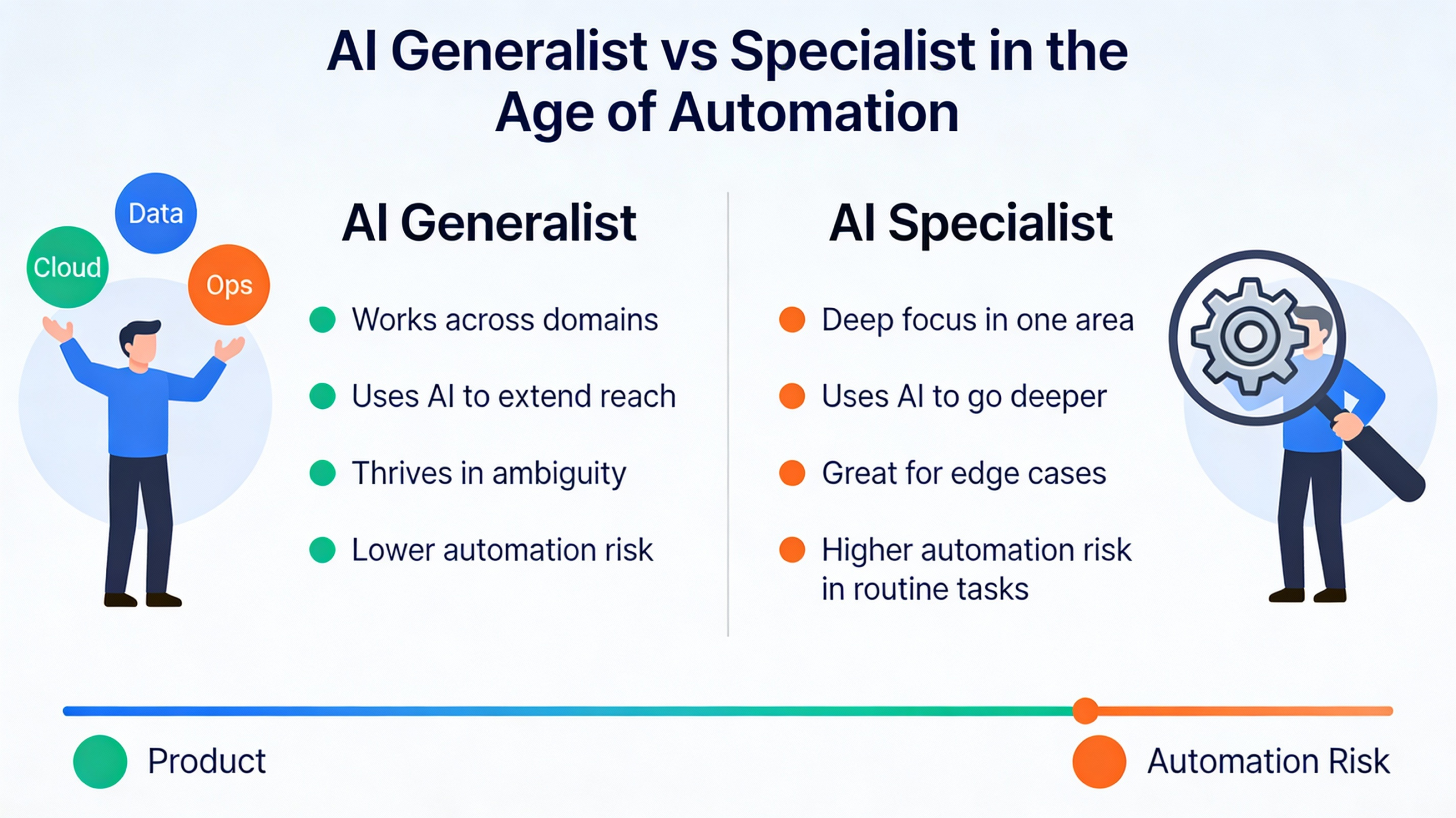
DimensionAI Generalist (T‑shaped / polymath)AI Specialist (deep domain expert)
Scope of workWorks across multiple domains (ML, Product, Ops, UX), stitches end-to-end solutions.Focuses on a narrow technical or domain slice, e.g., model optimization or infra scaling.
Core advantageContext switching, problem framing, integration, and using AI tools to move fast.Depth of insight, quality at the frontier, and solving hard edge cases.
Relationship to AIUses AI to extend reach across functions; or AI polymath.Uses AI to go deeper in a niche (e.g., better architectures, experiments, proofs).
Risk from automationLower: work involves ambiguity, coordination, and judgment across systems.Higher in routine, narrow tasks that AI can now codify and automate.
Typical rolesProduct‑minded engineers, founding team members, solution architects, AI strategists.Research scientists, core ML engineers, safety & reliability experts, domain‑heavy analysts.
Where they shineEarly‑stage products, zero‑to‑one initiatives, cross-functional transformations.Late‑stage optimization, regulated domains, and frontier R&D.

AI doesn’t make specialist knowledge obsolete – it makes specialist knowledge more productive, and generalist judgement more valuable.

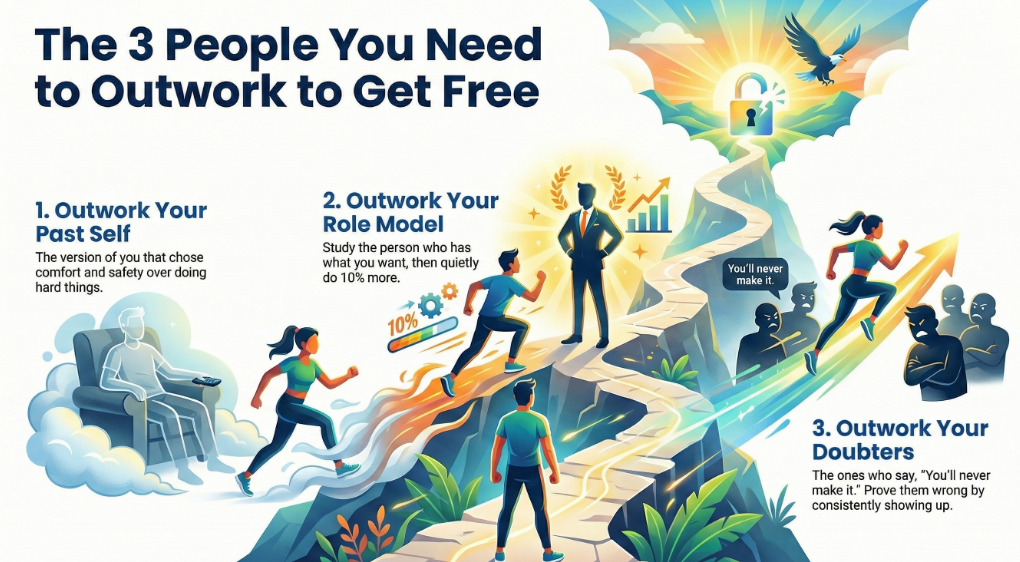
Many people believe that to achieve massive success, they must outwork the entire world.

However, you don’t actually need to beat billions of people; you only need to outwork three specific individuals to get ahead of life, to get rich and, more importantly, to get free.

1. The “Past You”

The “Past You” is the version of yourself that prioritized comfort and safety over success. This is the person who looked at a difficult task and decided to do it “later” or stayed in bed because it was warm.

Real-World Example: Imagine a budding entrepreneur who, for months, avoided the “hard thing” – like cold-calling potential clients or waking up at 5:00 AM to work on their business plan before their day job. To win, they must outwork that past version of themselves by doing those exact difficult tasks today that they put off yesterday.

2. The Person Who Already Has What You Want

Instead of falling into the trap of envy, you should study those who have already achieved your goals. Observe how they think, what they sacrificed to get there, and how they execute their daily tasks.

Real-World Example: If you are a salesperson aiming to be the top earner in your firm, don’t just watch the current leader with jealousy. Study their routine and then quietly do 10% more. If they make 50 calls a day, you make 55. If they stay until 6:00 PM, you stay until 6:30 PM. Doing one more call, one more rep, or one more late night is the key to eventually surpassing them.

3. The Person Counting on You to Quit

There will always be skeptics – the people who tell you that your idea is “too risky” or that you “aren’t built for this”. You don’t need to waste your energy arguing with them or trying to prove them wrong with words.

Real-World Example: Think of an athlete whose peers say they’ll never make the varsity team. The athlete doesn’t need to explain their talent; they simply need to keep showing up to every practice and putting in the work until their results become so undeniable that they can no longer be ignored.

The Path to Freedom

If you focus on outworking these three people long enough, you won’t just find get ahead of all those 99% people, you will achieve true freedom.

Success in this journey is like building a stone wall. You aren’t trying to build the whole wall in a day; you are simply focused on laying the next brick better than you did yesterday (outworking “Past You”), laying one more brick than the master mason next to you (outworking the person who has what you want), and continuing to lay bricks even when people say the wall will fall (outworking those counting on you to quit). Eventually, you have a fortress that no one can take away from you.

How to be the Top 1% Learner?

In an age where AI makes intelligence a commodity, your only real competitive edge is how fast you can learn and stay ahead. Most people fail because they try to “jam and cram” information into their prefrontal cortex, which acts like a “tiny cognitive bowl” that can only hold about four independent ideas at once.

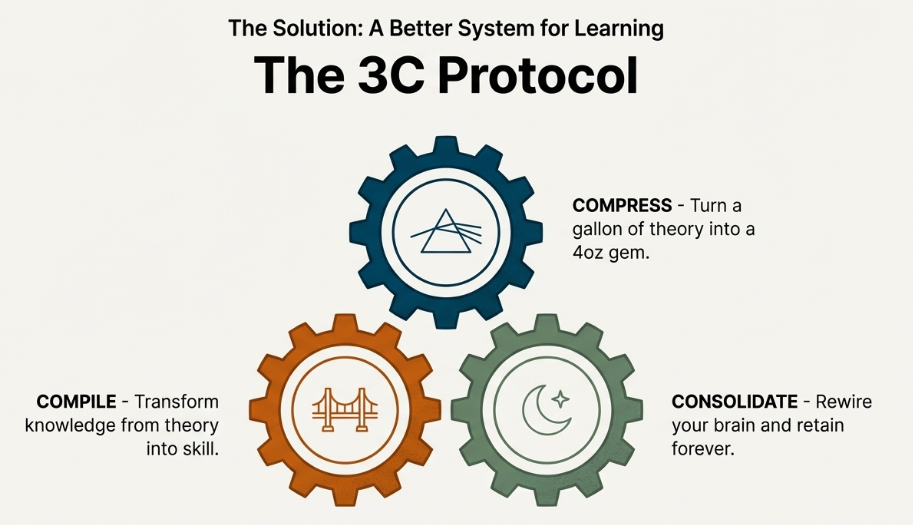
To break into the top 1% of learners, you must stop hoarding information and start using the 3C Protocol: Compress, Compile, and Consolidate.

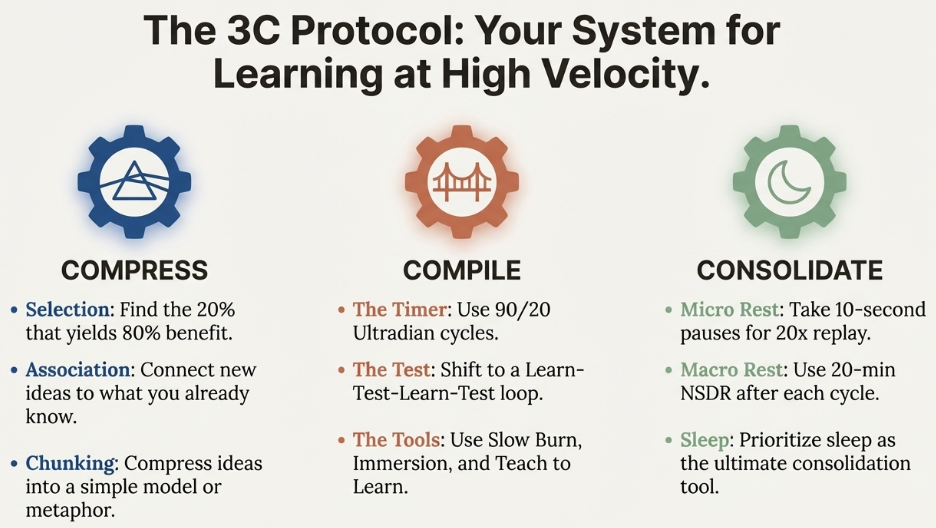
1. Compress: Turn Data into Patterns

The first step is reducing complex theories into small, manageable chunks that your brain can actually carry.

An Example (Chess): Grandmaster Magnus Carlson doesn’t memorize every possible move; instead, he has internalized up to 100,000 patterns. He wins by associating a new move on the board with an old pattern he already understands.

Actionable Tip: When reading a book, don’t read every page. Apply the 80/20 rule by selecting the 20% of chapters that provide 80% of the value. Connect these new ideas to something you already know and turn them into a simple drawing or metaphor.

2. Compile: Move from Consumption to Action

Mastery is not about what you can recall, but what you can do. The tragic story of savant Kim Peak – who could recall 12,000 books but struggled with basic daily chores – proves that memory alone is not mastery.

An Example (The Musician): If you are learning a physical skill like the guitar, use the “Slow Burn” tool. Play at an excruciatingly slow pace while maintaining intense focus on every micro-move. This ensures the brain is actively “compiling” the skill rather than operating on autopilot.

Actionable Tip: Use 90-minute “ultradian” focus blocks. Instead of waiting months for a final exam, create “agile” learning loops: learn, test, learn, test. You can even “teach to learn” by lecturing to a wall as if you were giving a TED talk to internalize the material.

3. Consolidate: Honor the Rest

Retention doesn’t happen while you are studying; it happens when you stop. Learning is a two-stage process where focus sends the “rewire” request, but rest is where the actual wiring occurs.

An Example (Farmer): Just as a farmer knows a field must rest to regain its fertility, a learner must manage rest at micro and macro levels.

Actionable Tip: Within your 90-minute work block, take 10-second micro-breaks. Research shows that during these pauses, your brain replays what you just learned at 10 to 20 times the speed, giving you “free reps” of practice. After your session, practice NSDR (non-sleep deep rest) or Yoga for 20 minutes to let your brain connect information without distractions.

The Mindset Shift

To succeed with the 3C Protocol, you must stop racing others and focus only on beating who you were yesterday. When you are in the middle of a learning session, be the performer, not the critic. If you feel friction, don’t quit – that struggle is the “generation effect” signaling that deep wiring is taking place.

Design Thinking for Data Science: A Human-Centric Approach to Solving Complex Problems

In the data-driven world, successful data science isn’t just about algorithms and statistics – it’s about solving real-world problems in ways that are impactful, understandable, and user-centered. This is where Design Thinking comes in. Originally developed for product and service design, Design Thinking is a problem-solving methodology that helps data scientists deeply understand the needs of their end-users, fostering a more human-centric approach to data solutions.

Let’s dive into the principles of Design Thinking, how it applies to data science, and why this mindset shift is valuable for creating impactful data-driven solutions.

What is Design Thinking?

Design Thinking is a methodology that encourages creative problem-solving through empathy, ideation, and iteration. It focuses on understanding users, redefining problems, and designing innovative solutions that meet their needs. Unlike traditional problem-solving methods, Design Thinking is nonlinear, meaning it doesn’t follow a strict sequence of steps but rather encourages looping back as needed to refine solutions.

The Five Stages of Design Thinking and Their Application to Data Science

Design Thinking has five main stages: Empathize, Define, Ideate, Prototype, and Test. Each stage is highly adaptable and beneficial for data science projects.

1. Empathize: Understand the User and Their Needs

Objective: Gain a deep understanding of the people involved and the problem context.

  • Data Science Application: Instead of jumping straight into data analysis, data scientists can start by interviewing stakeholders, observing end-users, and gathering insights on the problem context. This might involve learning about business needs, pain points, or specific user challenges.
  • Outcome: Developing empathy helps data scientists understand the human impact of the data solution. It frames data not just as numbers but as stories and insights that need to be translated into actionable outcomes.

Example: For a retail analytics project, a data scientist might meet with sales teams to understand their challenges with customer segmentation. They might discover that sales reps need more personalized customer insights, helping data scientists refine their approach and data features.

2. Define: Articulate the Problem Clearly

Objective: Narrow down and clearly define the problem based on insights from the empathizing stage.

  • Data Science Application: Translating observations and qualitative data from stakeholders into a precise, actionable problem statement is essential in data science. The problem statement should focus on the “why” behind the project and clarify how a solution will create value.
  • Outcome: This stage provides a clear direction for the data project, aligning it with the real-world needs and setting the foundation for effective data collection, model building, and analysis.

Example: In a predictive maintenance project for manufacturing, the problem statement could evolve from “analyze machine failure” to “predict machine failures to reduce downtime by 20%,” adding clarity and focus to the project’s goals.

3. Ideate: Generate a Range of Solutions

Objective: Brainstorm a variety of solutions, even unconventional ones, and consider multiple perspectives on how to approach the problem.

  • Data Science Application: In this stage, data scientists explore different analytical approaches, algorithms, and data sources. It’s a collaborative brainstorming session where creativity and experimentation take center stage, helping generate diverse methods for addressing the problem.
  • Outcome: Ideation leads to potential solution pathways and encourages teams to think beyond standard models or analysis techniques, considering how different data features or combinations might offer unique insights.

Example: For an employee attrition prediction project, ideation might involve brainstorming potential data features like employee tenure, manager interactions, and work-life balance. It could also involve considering various algorithms, from decision trees to deep learning, based on data availability and complexity.

4. Prototype: Build and Experiment with Solutions

Objective: Create a tangible representation of the solution, often in the form of a minimum viable product (MVP) or early-stage model.

  • Data Science Application: Prototyping in data science could involve building a quick initial model, conducting exploratory data analysis, or developing a dashboard that visualizes preliminary results. It’s about testing ideas rapidly to see which direction holds promise.
  • Outcome: Prototyping allows data scientists to see early results, gather feedback, and refine their models and visualizations. It’s a low-risk way to iterate on ideas before investing significant resources in a final solution.

Example: For a churn prediction project, the data team might create a basic logistic regression model and build a simple dashboard to visualize which factors are most influential. They can then gather feedback from the sales team on what insights are valuable and where they need more detail.

5. Test: Validate the Solution and Iterate

Objective: Test the prototype with real users or stakeholders, gather feedback, and make adjustments based on what you learn.

  • Data Science Application: Testing might involve showing stakeholders preliminary results, gathering feedback on model accuracy, or evaluating the solution’s usability. It’s about validating assumptions and refining the model or analysis based on real-world feedback.
  • Outcome: The testing phase helps data scientists ensure the model aligns with business objectives and addresses the end-users’ needs. Any gaps identified here allow for further refinement.

Example: If the initial churn model fails to predict high-risk customers accurately, data scientists can refine it by adding new features or using a more complex algorithm. Continuous feedback and iterations help the model evolve in alignment with user expectations and business goals.

How to Implement Design Thinking in Data Science Projects

  • Build Empathy: Hold interviews, run surveys, and spend time understanding end-users and stakeholders.
  • Define Clear Problem Statements: Regularly revisit the problem statement to ensure it aligns with real user needs.
  • Encourage Diverse Perspectives: Foster a team culture that values brainstorming and out-of-the-box thinking.
  • Prototype Early and Often: Don’t wait for the perfect model – use MVPs to test hypotheses and gather quick feedback.
  • Stay Iterative: Treat data science as an ongoing process, iterating on models and solutions based on user feedback and new insights.

For more details, read this interesting article written by Bill at DataScienceCentral website.

Credit: DataScienceCentral

Final Thoughts

Incorporating Design Thinking into data science transforms the way problems are approached, moving beyond data and algorithms to create solutions that are effective, empathetic, and impactful. This methodology is particularly valuable in data science, where the complexity of models can sometimes overshadow their practical applications.

By thinking more like a designer, data scientists can build solutions that not only solve technical challenges but also resonate with end-users and deliver measurable value. In an industry that’s increasingly focused on impact, adopting a Design Thinking mindset might just be the key to unlocking the full potential of data science.

T-shaped vs V-shaped path in your Analytics career

We start with learning multiple disciplines in an industry and then niche down to a specific skill that we master over the period of time to get expertise and become an authority in that space.

Typically, many including me follow a T-shaped path in the career journey where horizontal bar ‘T’ refers for wide variety of generalized knowledge / skills whereas vertical bar ‘T’ refers to depth of knowledge in a specific skill. For instance, if you’re a Data Scientist, you still do minimal Data Pre-Processing steps before doing the Exploratory Data Analysis, Model Training / Experimentation and Selection based on evaluation metrics. Although a Data Engineer or a Data Analyst, primarily works on data extraction, processing and visualization, a Data Scientist might still need to be familiar in order to get the job done on time without depending on the other team members.

Data Scientist’s vertical bar ‘T’ refers to crafting the best models for the dataset and horizontal bar ‘T’ could refer to Data processing (cleaning, transformation etc.) and visualizing the KPIs in the form of insights for the business to take informed decisions.

Strategy & Leadership consultant and author, Jeroen, comes up with a V-shaped path which makes sense in our contemporary economic situation where layoffs news are on the buzz across many MNC companies.

In terms of similarities, the author, reiterates that both models address the fact that understanding one focus area deeply and having shallow knowledge across other areas. V-shaped model refers to having one deep knowledge and a lot of adjacent knowledge areas which are not deeper but not shallow either, somewhere in between. Jeroen describes as, “It is medium-deep, medium-broad, enabling us to be versatile and agile.”

For illustration, if the Data Scientist aspires to go above and beyond the expectations, he/she can technically collaborate with Data Engineers, performs AI/ML modeling stuffs, builds reports/dashboards, generate meaningful insights, and enable end-user adoption of insights. It has a combination of hard and soft skills! Soft skills such as storytelling, collaboration with peers, project management etc., Over the period of time, as one repeats this whole process, they can get better and better (develop deeper knowledge) with model development and management, and develop adjacent soft skills to excel at work.

In my view, I think, we start with a T-shaped path and eventually, it morphs into a V-shaped career path as we put our hard-work on one skill and also develop its associated adjacent skills. And, it applies to any field that you’re in.

How long do you think it would take this transformation to attain a V-shaped path? Will this take about 10,000 hours (~a decade) as per Gladwell’s book: “Outliers” to become an expert? Maybe, yes! Sooner, the better it is!!

I’ll leave you with a three-phase approach to becoming an expert according to the author Jeroen.

Image Credits: https://www.linkedin.com/in/jeroenkraaijenbrink/