Agentic AI Revolution: From Data-Driven Decisions to Fully Autonomous Enterprises

For more than a decade, organizations have invested heavily in AI – collecting data, building models, and deploying dashboards. Yet despite massive AI adoption, a fundamental gap remains:

AI still waits for humans to act.

The next wave of AI doesn’t just analyze, predict, or generate.
It plans, decides, executes, and optimizes end to end.

This is the rise of Agentic AI.

The Evolution of AI: A Clear Progression

To understand why Agentic AI is transformative, we must view it as a natural evolution, not a sudden breakthrough.

1. AI & ML: Turning Data into Decisions

This is where most enterprises began.

  • Predict churn
  • Forecast demand
  • Optimize pricing
  • Detect fraud

Outcome:
Models generate insights → humans take actions.

AI answered “What should we do?”
Humans answered “Okay, now let’s do it.”

2. Deep Learning: Handling Complexity at Scale

Deep learning pushed AI beyond rules and feature engineering.

  • Image recognition
  • Speech-to-text
  • Recommendation engines
  • Natural language understanding

Outcome:
AI handled high-dimensional, unstructured data but still stopped short of execution.

3. Generative AI: Creating Content and Code

Generative AI unlocked unprecedented productivity.

  • Write content
  • Generate code
  • Summarize documents
  • Assist with reasoning

Outcome:
AI became a co-pilot, accelerating human workflows.

GenAI says: “Here’s the content/code.”
Humans still say: “I’ll decide what to do next.”

4. AI Agents: Executing Multi-Step Tasks

AI Agents introduced goal-oriented behavior.

An AI agent can:

  • Break a task into steps
  • Call tools and APIs
  • Observe outcomes
  • Adjust actions dynamically

Example:
A marketing agent that:

  • Analyzes campaign performance
  • Adjusts budget
  • Launches experiments
  • Reports results

Outcome:
AI started acting, not just assisting but usually within narrow tasks.

5. Agentic AI: Automating Entire Processes

This is where the real shift happens.

Agentic AI is not a single agent.
It is a system of coordinated AI agents that can:

  • Understand business goals
  • Design execution plans
  • Orchestrate multiple tools, models, and workflows
  • Learn from outcomes
  • Continuously optimize without human intervention

Agentic AI doesn’t ask “What should I generate?”
It asks “What outcome am I responsible for?”
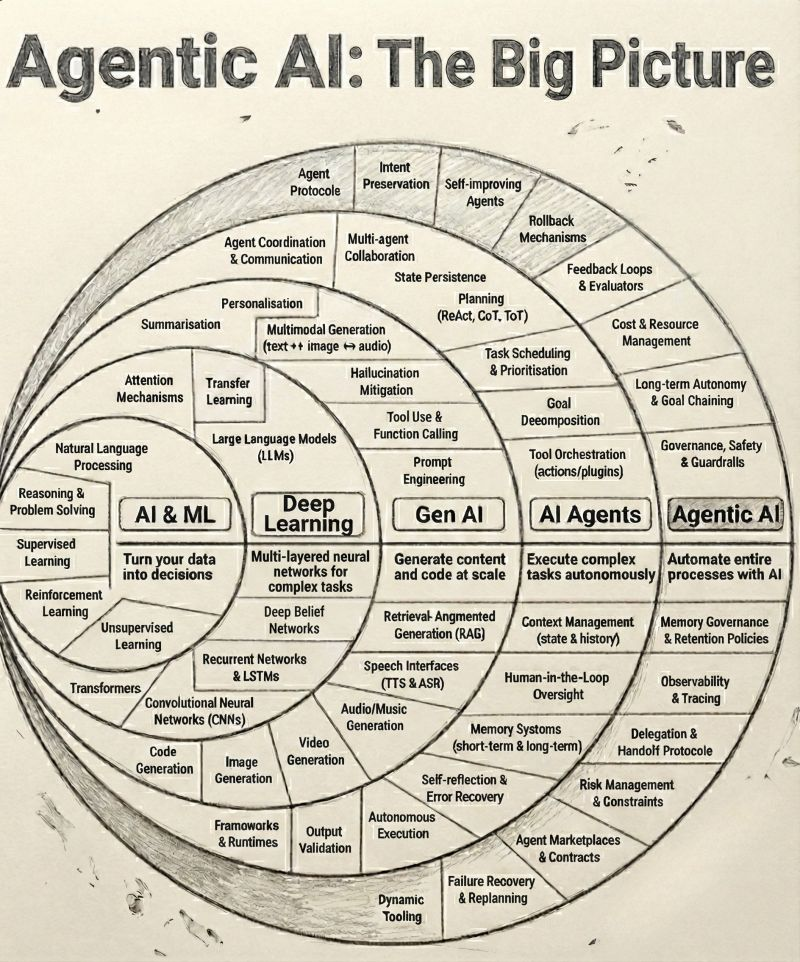
Image credit: https://www.linkedin.com/in/brijpandeyji/

What Makes Agentic AI Fundamentally Different?

CapabilityTraditional AIGenAIAgentic AI
Insights
Content Generation
Tool UsageLimited
Multi-step Planning
Autonomous Execution
Outcome Ownership

Agentic AI owns the full loop:
Goal → Plan → Act → Observe → Improve

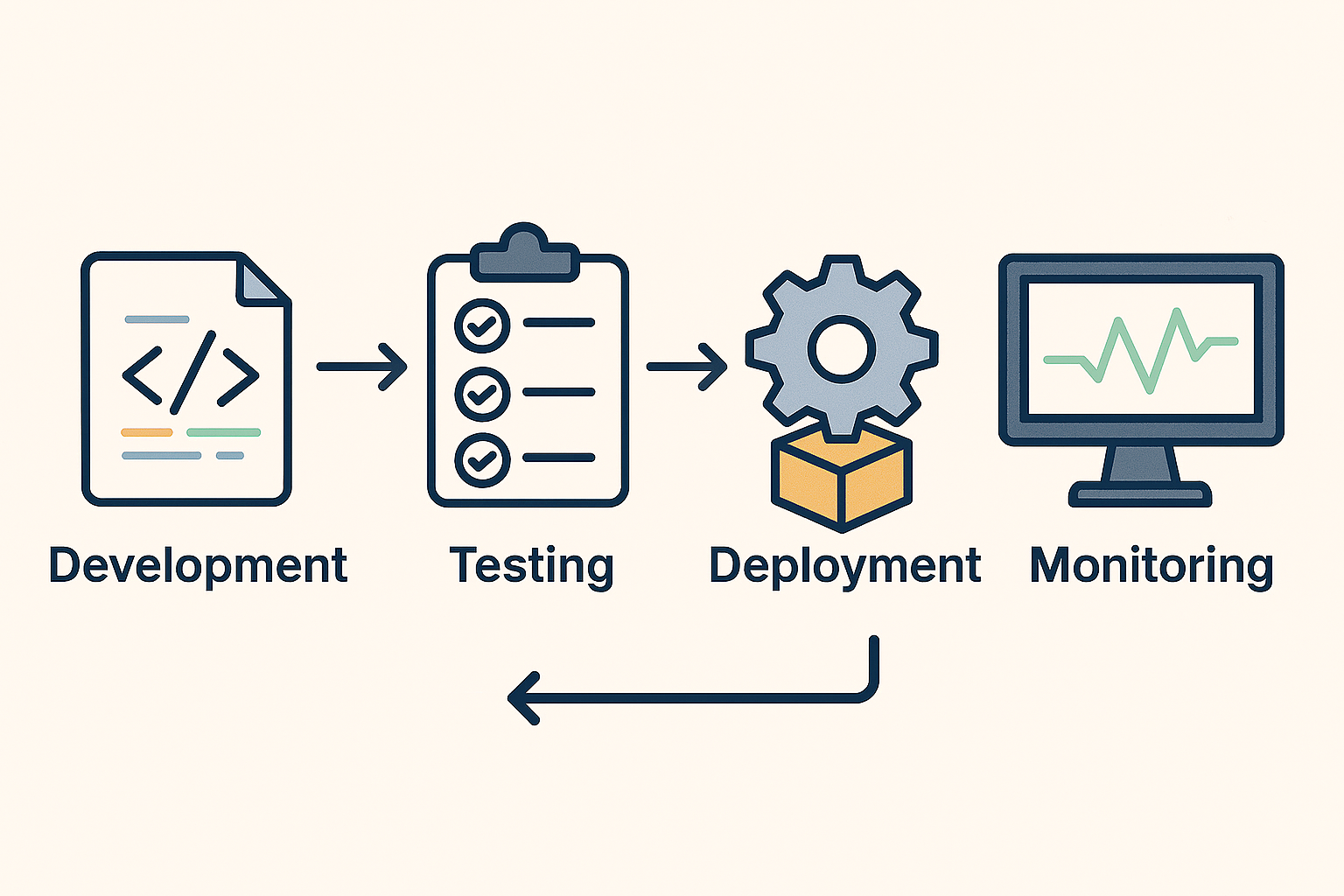
Shift-Left, Shift-Right: The Twin Strategies Powering Modern IT and Data Operations

In today’s always-on digital enterprises, downtime and performance issues come at a steep cost. The modern DevOps philosophy has redefined how organizations build, test, deploy, and manage software and data systems. Two terms: Shift-Left and Shift-Right capture this evolution perfectly.

These approaches are not just technical buzzwords; they represent a cultural and operational transformation from reactive troubleshooting to proactive prevention and continuous improvement.

1. What Does “Shift-Left” Mean?

Shift-Left” is all about moving quality and risk management earlier in the lifecycle, to the “left” of the traditional project timeline.

Historically, teams tested applications or validated data after development. By that stage, identifying and fixing issues became expensive and time-consuming.
Shift-Left reverses that by embedding testing, data validation, and quality assurance right from design and development.

Real-world example:

  • Microsoft uses Shift-Left practices by integrating automated unit tests and code analysis in its continuous integration (CI) pipeline. Each new feature or update is tested within minutes of being committed, drastically reducing post-release defects.
  • In a data engineering context, companies like Databricks and Snowflake promote Shift-Left Data Quality – validating schema, freshness, and business rules within the pipeline itself before data lands in analytics or AI systems.

Why it matters:

  • Reduces defects and rework
  • Improves developer productivity
  • Speeds up deployment cycles
  • Builds confidence in production releases

2. What Does “Shift-Right” Mean?

Shift-Right” extends testing and validation after deployment, to the “right” of the timeline. It’s about ensuring systems continue to perform and evolve once they’re live in production.

Rather than assuming everything works perfectly after release, Shift-Right emphasizes continuous feedback, monitoring, and learning from real user behavior.

Real-world example:

  • Netflix uses Shift-Right principles through its famous Chaos Engineering practice. By intentionally disrupting production systems (e.g., shutting down random servers), it tests the resilience of its streaming platform in real-world conditions.
  • Airbnb runs canary deployments and A/B tests to validate new features with a subset of users in production before a global rollout – ensuring a smooth and data-driven experience.

Why it matters:

  • Improves reliability and resilience
  • Enables real-time performance optimization
  • Drives continuous learning from production data
  • Enhances customer experience through fast iteration

3. When Shift-Left Meets Shift-Right

In modern enterprises, Shift-Left and Shift-Right are not opposites – they’re complementary halves of a continuous delivery loop.

  • Shift-Left ensures things are built right.
  • Shift-Right ensures they continue to run right.

Together, they create a closed feedback system where insights from production feedback into design and development creating a self-improving operational model.

Example synergy:

  • A global retailer might Shift-Left by embedding automated regression tests in its data pipelines.
  • It then Shifts-Right by using AI-based anomaly detection in production dashboards to monitor data drift, freshness, and latency.
  • Insights from production failures are looped back into early validation scripts closing the quality loop.

4. The AI & Automation Angle

Today, AI and AIOps (AI for IT Operations) are supercharging both shifts:

  • Shift-Left AI: Predictive code scanning, intelligent test generation, and synthetic data generation.
  • Shift-Right AI: Real-time anomaly detection, predictive incident management, and self-healing automation.

The result? Enterprises move from manual monitoring to autonomous operations, freeing up teams to focus on innovation instead of firefighting.

The future of enterprise IT and data operations isn’t about reacting to problems – it’s about preventing and learning from them continuously.
“Shift-Left” ensures quality is baked in early; “Shift-Right” ensures reliability is sustained over time.

Together, they represent the heart of a modern DevOps and DataOps culture — a loop of prevention, observation, and evolution.

Canary Deployment Explained: Reducing Production Risk in DevOps with Controlled Releases

Canary deployment is one of those DevOps terms that sounds abstract but is actually a very clever, real-world technique used by top tech companies like Netflix, Amazon, and Google.

Let’s unpack it in a clear, practical way –

What Is a Canary Deployment?

A canary deployment is a progressive rollout strategy where a new version of an application (or data pipeline, model, etc.) is released to a small subset of users or systems first, before deploying it to everyone.

The goal: Test in the real world, minimize risk, and catch issues early – without impacting all users.

Where the Name Comes From

The term comes from the old “canary in a coal mine” practice.

  • Miners used to carry a canary bird underground.
  • If dangerous gases were present, the bird would show distress first – warning miners before it was too late.

Similarly, in software deployment:

  • The “canary group” gets the new version first.
  • If problems occur (e.g., errors, latency spikes, or crashes), the rollout stops or rolls back.
  • If all looks good, the new version gradually reaches 100% of users.

How It Works in Practice

Here’s the step-by-step flow:

  1. Deploy new version (v2) to a small portion of traffic (say 5-10%).
  2. Monitor key metrics: performance, error rates, user engagement, latency, etc.
  3. Compare results between the canary version and the stable version (v1).
  4. If KPIs are healthy, automatically scale up rollout (20%, 50%, 100%).
  5. If issues arise, rollback instantly to the previous version.

Example Scenarios

1) Web / App Deployment

A global streaming platform like Netflix releases a new recommendation algorithm:

  • First, 5% of users in Canada get the new algorithm.
  • Netflix monitors playback time, user retention, and error logs.
  • If everything looks good, it expands to North America, then globally.

2) Data Pipeline or Analytics System

A retailer introduces a new real-time data ingestion flow:

  • It runs in parallel with the old batch flow for one region (the canary).
  • Teams compare data accuracy, latency, and system load.
  • After validation, the new pipeline fully replaces the old one.

Benefits

BenefitDescription
Reduced RiskProblems affect only a small user group initially
Faster FeedbackReal-world validation of performance & stability
Controlled RolloutGradual scaling based on metrics
Easy RollbackQuick reversion to the stable version if issues occur

Challenges

  • Requires strong observability and real-time monitoring tools (like Datadog, Prometheus, or Azure Monitor).
  • Needs automated rollback scripts and infrastructure-as-code setup.
  • Works best in containerized environments (Kubernetes, Docker, etc.) for version control and isolation.

In Summary

Canary deployment = “Release small, observe fast, scale safely.”

It’s a smart middle ground between risky full releases and overly cautious manual rollouts – ensuring continuous innovation with minimal disruption.

Databricks AI/BI: What It Is & Why Enterprises Should Care

In the world of data, modern enterprises wrestle with three big challenges: speed, accuracy, and usability. You want insights fast, you want them reliable, and you want non‐technical people (execs, marketers, operations) to be able to get value without depending constantly on data engineers.

That’s where Databricks AI/BI comes in—a newer offering from Databricks that blends business intelligence with AI so that insights become more accessible, real‐time, and trustworthy.

What is Databricks AI/BI?

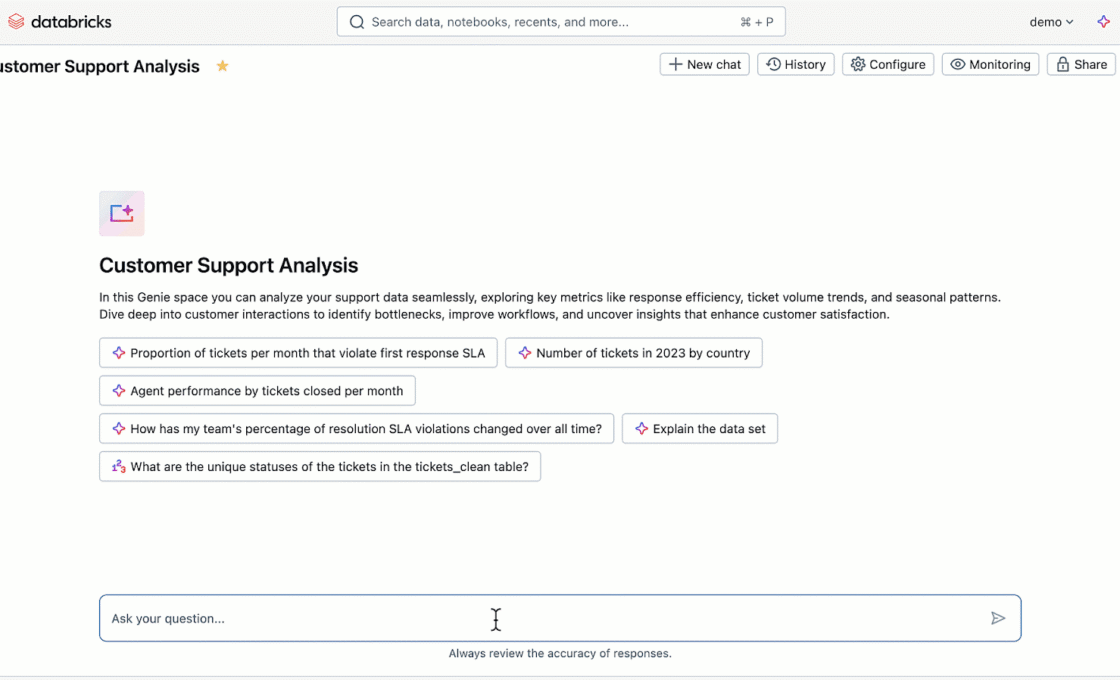
Databricks AI/BI is a product suite that combines a low-code / no-code dashboarding environment with a conversational interface powered by AI. Key components include:

  • AI/BI Dashboards: Allows users to create interactive dashboards and visualizations, often using drag-and-drop or natural-language prompts. The dashboards integrate with Databricks’ SQL warehouses and the Photon engine for high performance.
  • Genie: A conversational, generative-AI interface where users can ask questions in natural language, get responses in visuals or SQL, dig deeper through follow-ups, get suggested visualizations, etc. It learns over time via usage and feedback.
  • Built on top of Unity Catalog, which handles governance, lineage, permissions. This ensures that all dashboards or responses are trustable and auditable.
  • Native integration with Databricks’ data platform (SQL warehouses, Photon engine, etc.), so enterprises don’t need to extract data elsewhere for BI. This improves freshness, lowers duplication and simplifies management.

Databricks Genie

AI/BI Genie uses a compound AI system rather than a single, monolithic AI model.

Matei Zaharia and Ali Ghodsi, two of the founders of Databricks, describe a compound AI system as one that “tackles AI tasks using multiple interacting components, including multiple calls to models, retrievers, or external tools.”

Use Cases: How Enterprises Are Using AI/BI

Here are some of the ways enterprises are applying it, or can apply it:

  1. Ad-hoc investigations of customer behaviour
    Business users (marketing, product) can use Genie to ask questions like “Which customer cohorts churned in last quarter?” or “How did a campaign perform in region X vs Y?”, without waiting for engineers to build SQL pipelines.
  2. Operational dashboards for teams
    For operations, supply chain, finance etc., dashboards that update frequently, with interactive filtering, cross-visualization slicing, giving teams real-time monitoring.
  3. Reducing the BI backlog and bottlenecks
    When data teams are overwhelmed by requests for new dashboards, having tools that enable business users to do more themselves frees up engineering to focus on more strategic work (data pipelines, ML etc.).
  4. Governance and compliance
    Enterprises in regulated industries (finance, healthcare, etc.) need traceability: where data came from, who used it, what transformations it passed through. With Unity Catalog lineage + trusted assets in Databricks, AI/BI supports that.
  5. Data democratization
    Spreading data literacy: by lowering the barrier, a wider set of users can explore, ask questions, derive insights. This builds a data culture.
  6. Integration with ML / AI workflows
    Because it’s on Databricks, it’s easier to connect dashboards & conversational insights with predictive models, possibly bringing in forecasts, anomaly detection etc., or even embedding BI into AI‐powered apps.

Comparison

FeatureDatabricks AI/BI + GenieTableau Ask DataPower BI (with Copilot / Q&A)
Parent PlatformDatabricks Lakehouse (unified data, AI & BI)Tableau / Salesforce ecosystemMicrosoft Fabric / Power Platform
Core VisionUnify data, AI, and BI in one governed Lakehouse. BI happens where data lives.Simplify visualization creation via natural language.Infuse Copilot into all Microsoft tools — including BI — for everyday productivity.
AI LayerGenie – a generative AI agent trained on enterprise data, governed by Unity Catalog.Ask Data – NLP-based query translation for Tableau data sources.Copilot / Q&A – GPT-powered natural language for Power BI datasets, integrated into Fabric.
Underlying Data ModelDatabricks SQL Warehouse (Photon Engine) – operates directly on Lakehouse data (no extracts).Extract-based (Hyper engine) or live connection to relational DBs.Semantic Model / Tabular Dataset inside Power BI Service.
GovernanceStrong – via Unity Catalog (data lineage, permissions, certified datasets).Moderate – uses Tableau permissions and data source governance.Strong – via Microsoft Purview + Fabric unified governance.
User ExperienceConversational (chat-style) + dashboard creation. Unified with AI/BI dashboards.Type queries in Ask Data → generates visual. Embedded inside Tableau dashboards.Ask natural language inside Power BI (Q&A) or use Copilot to auto-build visuals/reports.
PerformanceVery high (Photon vectorized execution). Real-time queries on raw or curated data.Depends on extract refresh or live connection.Excellent on in-memory Tabular Models; limited by dataset size.
AI CustomizationUses enterprise metadata from Unity Catalog; can fine-tune prompts with context.Limited NLP customization (no fine-tuning).Some customization using “synonyms” and semantic model metadata.
Integration with ML/AI ModelsNatively integrated (Lakehouse supports MLflow, feature store, LLMOps).External ML integration (via Salesforce Einstein or Python).Integrated via Microsoft Fabric + Azure ML.
Ideal User PersonaEnterprises already in Databricks ecosystem (data engineers, analysts, PMs, CXOs).Business analysts and Tableau users who want easier visual exploration.Office 365 / Azure enterprises seeking seamless Copilot-powered analytics.

Conclusion

Databricks AI/BI is a powerful step forward in the evolution of enterprise analytics. It blends BI and AI so that enterprises can move faster, more securely, and more democratically with their data.

All three tools represent the evolution of Business Intelligence toward “AI-Native BI.” But here’s the philosophical difference:

  • Tableau → still visualization-first, AI as a helper.
  • Power BI → productivity-first, AI as a co-pilot.
  • Databricksdata-first, AI as the core intelligence layer that unifies data, analytics, and governance.

For organizations that already use Databricks or are building a data lakehouse / unified analytics platform, AI/BI offers a way to deprecate some complex pipelines, reduce their BI backlog, bring more teams into analytics, while maintaining governance and performance.

References:

https://learn.microsoft.com/en-us/azure/databricks/genie

https://atlan.com/know/databricks/databricks-ai-bi-genie

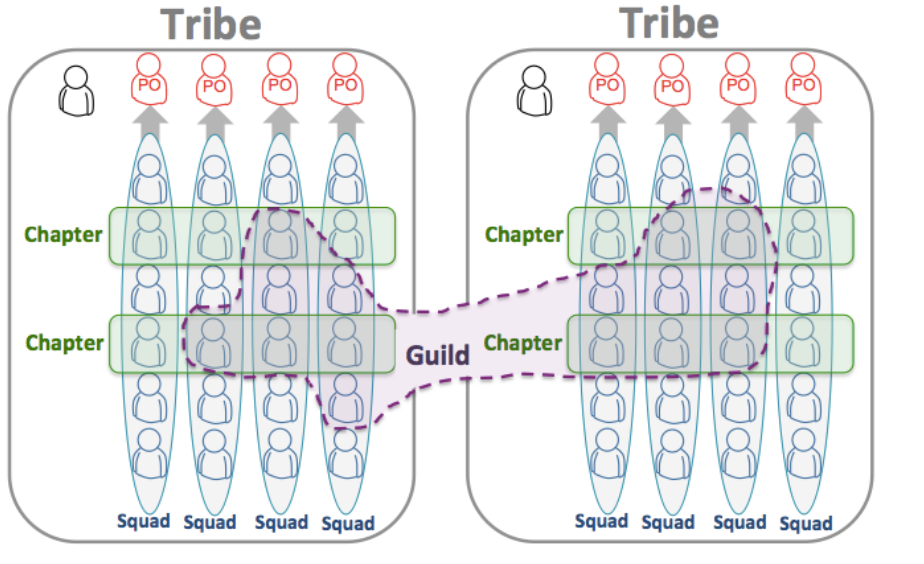
Understanding Tribes, Guilds, Pods/Squads in Agile

When working with large enterprises, understanding the organizational constructs of scaled Agile deliveryTribes, Guilds, Pods, ARTs, PI Planning, and more – is critical. These aren’t just buzzwords; they define how data, analytics, and product teams operate together at scale under frameworks like SAFe (Scaled Agile Framework) or Spotify Model (which many organizations have blended).

Let’s unpack everything in simple, visual-friendly terms

Big Picture: Why These Structures Exist

When Agile scaled beyond small software teams, companies realized:

  • One team can’t own end-to-end delivery for large systems.
  • But dozens of Agile teams working in silos = chaos.
  • Hence, Scaled Agile introduced structures that balance autonomy + alignment.

That’s where Tribes, Pods, Guilds, ARTs, Value Streams, and Chapters come in.

Key Organizational Constructs in SAFe + Spotify-style Agile

TermOriginWhat It MeansTypical Use in D&A / Tech Organizations
PodSpotify modelA small, cross-functional team (6–10 people) focused on a single feature, domain, or use-case.e.g., “Revenue Analytics Pod” with Data Engineer, BI Developer, Data Scientist, Product Owner.
SquadSpotify modelSimilar to a Pod — autonomous Agile team that delivers end-to-end functionality.e.g., “Guest Personalization Squad” responsible for AI-driven recommendations.
TribeSpotify modelA collection of related Pods/Squads working on a common business domain.e.g., “Customer 360 Tribe” managing all loyalty, guest data, and personalization products.
ChapterSpotify modelA functional community across squads — ensures consistency in technical skills, tools, and best practices.e.g., Data Engineering Chapter, BI Chapter, Data Science Chapter.
GuildSpotify modelA community of interest that cuts across the org — informal learning or best-practice sharing group.e.g., Cloud Cost Optimization Guild, AI Ethics Guild.
ART (Agile Release Train)SAFeA virtual organization (50–125 people) of multiple Agile teams aligned to a common mission & cadence (PI).e.g., “D&A Platform ART” delivering all analytics platform capabilities.
Value StreamSAFeA higher-level grouping of ARTs focused on delivering a business outcome.e.g., “Customer Experience Value Stream” containing ARTs for loyalty, personalization, and customer analytics.
PI (Program Increment)SAFeA fixed timebox (8–12 weeks) for ARTs to plan, execute, and deliver.Enterprises do PI Planning quarterly across D&A initiatives.
RTE (Release Train Engineer)SAFeThe chief scrum master of the ART — facilitates PI planning, removes impediments.Coordinates between multiple pods/squads.
Product Owner (PO)AgileOwns the team backlog; defines user stories and acceptance criteria.Often aligned with one pod/squad.
Product Manager (PM)SAFeOwns the program backlog (features/epics) and aligns with business outcomes.Defines strategic direction for ART or Tribe.
Solution TrainSAFeCoordinates multiple ARTs when the solution is large (enterprise-level).e.g., Enterprises coordinating multiple ARTs for org-wide data modernization.
CoE (Center of Excellence)Enterprise termA centralized body for governance, standards, and enablement.e.g., Data Governance CoE, AI/ML CoE, BI CoE.

What is unique with Spotify-model?

The Spotify model champions team autonomy, so that each team (or Squad) selects their framework (e.g. Scrum, Kanban, Scrumban, etc.). Squads are organized into Tribes and Guilds to help keep people aligned and cross-pollinate knowledge. For more details on this, I encourage you to read this article.

There is also one more useful material on Scaling Agile @ Spotify.

Simplified Analogy

Think of a cruise ship 🙂

Cruise ConceptAgile Equivalent
The ShipThe Value Stream (business goal)
Each DeckAn ART (Agile Release Train) – a functional area like Guest Analytics or Revenue Ops
Each Department on DeckA Tribe (Marketing, Data, IT Ops)
Teams within DepartmentPods/Squads working on features
Crew with Same Skill (Chefs, Engineers)Chapters – same skill family
Community of Passion (Wine Enthusiasts)Guilds – voluntary learning groups
Captain / OfficersRTE / Product Manager / Architects

In a Data & Analytics Organization (Example Mapping)

Agile ConstructD&A Example
Pod / SquadLoyalty Analytics Pod building retention dashboards and models.
TribeCustomer 360 Tribe uniting Data Engineering, Data Science, and BI pods.
ChapterData Quality Chapter ensuring consistent metrics, lineage, and governance.
GuildAI Experimentation Guild sharing learnings across data scientists.
ARTD&A Platform ART orchestrating data ingestion, governance, and MLOps.
PI PlanningQuarterly sync for backlog prioritization and dependency resolution.
RTE / PMEnsuring alignment between business priorities and data delivery roadmap.

Summary

  • Pods/Squads → Smallest Agile unit delivering value.
  • Tribes → Group of pods delivering a shared outcome.
  • Chapters → Skill-based group ensuring quality & standards.
  • Guilds → Interest-based communities sharing best practices.
  • ARTs / Value Streams → SAFe structures aligning all of the above under a common business mission.
  • PI Planning → The synchronization event to plan and execute at scale.
Vibe Coding: The Future of Intuitive Human-AI Collaboration

In the last decade, coding has undergone multiple evolutions – from low-code to no-code platforms, and now, a new paradigm is emerging: Vibe Coding. Unlike traditional coding that demands syntax mastery, vibe coding focuses on intent-first interactions, where humans express their needs in natural language or even visual/gestural cues, and AI translates those “vibes” into functional code or workflows.

Vibe coding is the emerging practice of expressing your intent in natural language – then letting artificial intelligence (AI), typically a large language model (LLM), turn your request into real code. Instead of meticulously writing each line, users guide the AI through prompts and incremental feedback.

The phrase, popularized in 2025 by Andrej Karpathy, means you focus on the big-picture “vibes” of your project, while AI brings your app, script, or automation to life. Think of it as shifting from “telling the computer what to do line by line” to “expressing what you want to achieve, and letting AI figure out the how.”

What Exactly Is Vibe Coding?

Vibe coding is the practice of using natural, context-driven prompts to co-create software, analytics models, or workflows with AI. Instead of spending time memorizing frameworks, APIs, or libraries, you explain the outcome you want, and the system translates it into executable code.

It’s not just about speeding up development — it’s about democratizing problem-solving for everyone, not just developers.

Who Can Benefit from Vibe Coding?

1. Software Developers

  • Use Case: A full-stack developer wants to prototype a new feature for a web app. Instead of manually configuring routes, data models, and UI components, they describe:
    “Build me a login page with Google and Apple SSO, a dark theme toggle, and responsive design.”
  • Impact: Developers move from repetitive coding to higher-order design and architecture decisions.
  • Tools: GitHub Copilot, Replit, Cursor IDE.

2. Data Scientists

  • Use Case: A data scientist is exploring customer churn in retail. Instead of hand-coding all preprocessing, they vibe with the AI:
    “Clean this dataset, remove outliers, and generate the top 5 predictors of churn with SHAP explanations.”
  • Impact: Faster experimentation and less time lost in boilerplate tasks like data cleaning.
  • Tools: Jupyter Notebooks with AI assistants, Dataiku

3. Business Professionals (Non-Technical Users)

  • Use Case: A marketing manager needs a personalized email campaign targeting lapsed customers. Instead of calling IT or external agencies, they simply ask:
    “Create a 3-email reactivation journey for customers who haven’t purchased in 90 days, with subject lines optimized for open rates.”
  • Impact: Empowers business teams to execute data-driven campaigns without technical bottlenecks.
  • Tools: Jasper, Canva, HubSpot with AI assistants, ChatGPT plugins.

Case-study: Vanguard & the Webpage-Prototype Case in Vibe Coding

“Even financial giants like Vanguard are using vibe coding to prototype webpages — cutting design/prototyping time from ~two weeks to ~20 minutes.”

Vanguard’s Divisional Chief Information Officer for Financial Adviser Services (Wilkinson) described how Vanguard’s team (product + design + engineering) is using vibe coding to build new webpages more quickly. Andrew Maddox

They reported that a new webpage which used to take ~2 weeks to design/prototype now takes 20 minutes via this vibe-coding process. That’s about a 40% speedup (or more, depending on what part of the process you’re comparing) in prototyping/design handoff etc.

The caveat: engineers are still very involved — particularly in defining boundaries, quality / security guard rails, ensuring what the AI or product/design people produce makes sense and is safe / maintainable.

Why Vibe Coding Matters

  • Bridges the gap between technical and non-technical stakeholders.
  • Accelerates innovation by reducing time spent on repetitive, low-value tasks.
  • Fosters creativity, allowing people to focus on “what” they want instead of “how” to build it.
  • Democratizes AI/ML adoption, giving even small businesses the ability to leverage advanced tools.

  • Lovable: Full-stack web apps; “dream out loud, deploy in minutes”.
  • Bolt: Integrates with Figma, GitHub, Stripe; great for visual + technical users.
  • Cursor: Chat-based AI coding, integrates with local IDE and version control.
  • Replit: Cloud IDE, easy deployment, collaborative.
  • Zapier Agents: No-code workflows automated by AI

The Road Ahead

Vibe coding is not about replacing developers, analysts, or business strategists — it’s about elevating them. The people who thrive in this new era won’t just be coders; they’ll be designers of intent, skilled in articulating problems and curating AI-driven solutions.

In the future, asking “what’s the vibe?” may not just be slang — it might be the most powerful way to code.

The Smartest AI Models: IQ, Mensa Tests, and Human Context

AI models are constantly surprising us – but how smart are they, really?

A recent infographic from Visual Capitalist ranks 24 leading AI systems by their performance on the Mensa Norway IQ test, revealing that even the best AI can outperform the average human.

AI Intelligence, by the Numbers

Visual Capitalist’s analysis shows AI models scoring across categories:

  • “Highly intelligent” class (>130 IQ)
  • “Genius” level (>140 IQ) with the top performers
  • Models below 100 IQ still fall in average or above-average ranges

For context, the average adult human IQ is 100, with scores between 90–110 considered the norm.

Humans vs. Machines: A Real-World Anecdote

Imagine interviewing your colleague, who once aced her undergrad finals with flying colors – she might score around 120 IQ. She’s smart, quick-thinking, adaptable.

Now plug her into a Mensa Norway-style test. She does well but places below the top AI models.

That’s where the surprise comes in: these AI models answer complex reasoning puzzles in seconds, with more consistency than even the smartest human brains. They’re in that “genius” club – but wholly lacking human intuition, creativity, or emotion.

What This IQ Comparison Really Shows

InsightWhy It Matters
AI excels at structured reasoning testsBut real-world intelligence requires more: creativity, ethics, emotional understanding.
AI IQ is a performance metric – not characterModels are powerful tools, not sentient beings.
Human + AI = unbeatable comboMerging machine rigor with human intuition unlocks the best outcomes.

Caveats: Why IQ Isn’t Everything

  • These AI models are trained on test formats – they’re not “thinking” or “understanding” in a human sense.
  • IQ tests don’t measure emotional intelligence, empathy, or domain-specific creativity.
  • A “genius-level” AI might ace logic puzzles, but still struggle with open-ended tasks or novel situations.

Key Takeaway

AI models are achieving IQ scores that place them alongside the brightest humans – surpassing 140 on standardized Mensa-style tests . But while they shine at structured reasoning, they remain tools, not people.

The real power lies in partnering with them – combining human creativity, ethics, and context with machine precision. That’s where true innovation happens.

Forbes AI 50 2025: The Coolest AI Startups and Technologies Shaping the Future

The AI landscape is evolving at warp speed, and the Forbes AI 50 2025 “Visualized” chart offers a fascinating snapshot of the companies driving this revolution. Moving beyond just answering questions, these innovators are building the infrastructure and applications that will define how we live and work in the coming years.

Let’s dive into some of the truly interesting and “cool” brands and products highlighted in this essential map:

1. The Creative Powerhouses: Midjourney & Pika (Consumer Apps – Creative)

If you’ve seen mind-bending digital art or short, generated video clips flooding your social feeds, you’ve likely witnessed the magic of Midjourney and Pika. These platforms are at the forefront of generative AI for media.

Midjourney continues to push the boundaries of text-to-image synthesis, creating incredibly realistic and artistic visuals from simple text prompts.

Pika, on the other hand, is democratizing video creation, allowing users to generate and manipulate video clips with impressive ease. They’re making professional-grade creative tools accessible to everyone, empowering artists, marketers, and casual creators alike.

2. The Voice of the Future: ElevenLabs (Vertical Enterprise – Creative)

Beyond just text and images, ElevenLabs is making waves in AI-powered voice generation. Their technology can produce incredibly natural-sounding speech, replicate voices with stunning accuracy, and even translate spoken content while maintaining the speaker’s unique vocal characteristics. This is a game-changer for audiobooks, gaming, virtual assistants, and accessibility, blurring the line between human and synthesized voice in fascinating (and sometimes spooky!) ways.

3. The Humanoid Frontier: FIGURE (Robotics)

Stepping into the realm of the physical, FIGURE represents the cutting edge of humanoid robotics. While still in early stages, their goal is to develop general-purpose humanoid robots that can perform complex tasks in real-world environments. This isn’t just about automation; it’s about creating versatile machines that can adapt to human spaces and assist in diverse industries, from logistics to elder care. The sheer ambition and engineering challenge here are nothing short of cool.

4. The Language Architects: Anthropic & Mistral AI (Infrastructure – Foundation Model Providers)

While OpenAI’s ChatGPT often grabs headlines, Anthropic (with its Claude model) and Mistral AI are critical players building the very foundation models that power many AI applications.

Anthropic emphasizes AI safety and responsible development, while Mistral AI is gaining significant traction for its powerful yet compact open-source models, which offer a compelling alternative for developers and enterprises seeking flexibility and efficiency. These companies are the unsung heroes building the bedrock of the AI revolution.

5. The Data Powerhouse: Snowflake (Infrastructure – Data Storage)

Every cool AI application, every smart model, every powerful insight depends on one thing: data. Snowflake continues to dominate as a leading cloud data warehouse and data lakehouse platform. It enables seamless data storage, processing, and sharing across organizations, making it possible for AI models to access and learn from massive, diverse datasets. Snowflake is the invisible backbone supporting countless data-driven innovations.

6. The AI Chip Giants: NVIDIA & AMD (Infrastructure – Hardware)

None of this AI magic would be possible without the raw computational power provided by advanced semiconductor hardware. NVIDIA and AMD are the titans of this space, designing the GPUs (Graphics Processing Units) and specialized AI chips that are literally the “brains” enabling large language models, vision models, and complex AI computations. Their relentless innovation in silicon design directly fuels the AI industry’s explosive growth.

The Forbes AI 50 2025 map is a vibrant testament to the incredible innovation happening in artificial intelligence. From creating compelling content to building intelligent robots and the foundational infrastructure, these companies are not just predicting the future – they are actively building it, one fascinating product at a time.

Credits: https://www.sequoiacap.com/article/ai-50-2025/

GenAI is Not Equal to NLP: Understanding the Key Differences

Introduction

In the rapidly evolving world of artificial intelligence (AI), terms like Generative AI (GenAI) and Natural Language Processing (NLP) are often used interchangeably, leading to confusion. While both fields are closely related and often overlap, they are not the same thing. Understanding the distinctions between them is crucial for businesses, developers, and AI enthusiasts looking to leverage these technologies effectively.

In this article, we’ll break down:

  • What NLP is and its primary applications
  • What GenAI is and how it differs from NLP
  • Where the two fields intersect
  • Why the distinction matters

What is Natural Language Processing (NLP)?

Natural Language Processing (NLP) is a subfield of AI focused on enabling computers to understand, interpret, and manipulate human language. It involves tasks such as:

  • Text classification (e.g., spam detection, sentiment analysis)
  • Named Entity Recognition (NER) (identifying names, dates, locations in text)
  • Machine Translation (e.g., Google Translate)
  • Speech Recognition (e.g., Siri, Alexa)
  • Question Answering (e.g., chatbots, search engines)

NLP relies heavily on linguistic rules, statistical models, and machine learning to process structured and unstructured language data. Traditional NLP systems were rule-based, but modern NLP leverages deep learning (e.g., Transformer models like BERT, GPT) for more advanced capabilities.

What is Generative AI (GenAI)?

Generative AI (GenAI) refers to AI models that can generate new content, such as text, images, music, or even code. Unlike NLP, which primarily focuses on understanding and processing language, GenAI is about creating original outputs.

Key examples of GenAI include:

  • Text Generation (e.g., ChatGPT, Claude, Gemini)
  • Image Generation (e.g., DALL·E, Midjourney, Stable Diffusion)
  • Code Generation (e.g., GitHub Copilot)
  • Audio & Video Synthesis (e.g., AI voice clones, deepfake videos)

GenAI models are typically built on large language models (LLMs) or diffusion models (for images/videos) and are trained on massive datasets to produce human-like outputs.

Key Differences Between NLP and GenAI

FeatureNLPGenAI
Primary GoalUnderstand & process languageGenerate new content
ApplicationsTranslation, sentiment analysisText/image/code generation
OutputStructured analysis (e.g., labels)Creative content (e.g., essays, art)
Models UsedBERT, spaCy, NLTKGPT-4, DALL·E, Stable Diffusion
FocusAccuracy in language tasksCreativity & novelty in outputs

Where Do NLP and GenAI Overlap?

While they serve different purposes, NLP and GenAI often intersect:

  1. LLMs (Like GPT-4): These models are trained using NLP techniques but are used for generative tasks.
  2. Chatbots: Some use NLP for understanding queries and GenAI for generating responses.
  3. Summarization: NLP extracts key information; GenAI rewrites it in a new form.

However, not all NLP is generative, and not all GenAI is language-based (e.g., image generators).

Why Does This Distinction Matter?

  1. Choosing the Right Tool
    • Need text analysis? Use NLP models like BERT.
    • Need creative writing? Use GenAI like ChatGPT.
  2. Ethical & Business Implications
    • NLP biases affect decision-making.
    • GenAI raises concerns about misinformation, copyright, and deepfakes.
  3. Technical Implementation
    • NLP pipelines focus on data preprocessing, tokenization, and classification.
    • GenAI requires prompt engineering, fine-tuning for creativity, and safety checks.

Conclusion

While NLP and GenAI are related, they serve fundamentally different purposes:

  • NLP = Understanding language.
  • GenAI = Creating new content.

As AI continues to evolve, recognizing these differences will help businesses, developers, and policymakers deploy the right solutions for their needs.

Essential Frameworks to Implement AI the Right Way

Artificial Intelligence (AI) is transforming industries – From startups to Fortune 500s, businesses are racing to embed AI into their core operations. However, AI implementation isn’t just about adopting the latest model; it requires a structured, strategic approach.

To navigate this complexity, Tim has suggested 6 AI Usage Frameworks for Developing the Organizational AI Adoption Plan.

Microsoft’s AI Maturity Model
proposes the stages of AI adoption in organizations and how human involvement changes at each stage:
Assisted Intelligence: AI provides insights, but humans make decisions.
Augmented Intelligence: AI enhances human decision-making and creativity.Mic
Autonomous Intelligence: AI makes decisions without human involvement.

PwC’s AI Augmentation Spectrum highlights six stages of human-AI collaboration:
AI as an Advisor: Providing insights and recommendations.
AI as an Assistant: Helping humans perform tasks more efficiently.
AI as a Co-Creator: Working collaboratively on tasks.
AI as an Executor: Performing tasks with minimal human input.
AI as a Decision-Maker: Making decisions independently.
AI as a Self-Learner: Learning from tasks to improve over time.

Deloitte’s The Augmented Intelligence Framework
Deloitte’s Augmented Intelligence Framework focuses on the collaborative nature of AI and human tasks, highlighting the balance between automation and augmentation:
Automate: AI takes over repetitive, rule-based tasks.
Augment: AI provides recommendations or insights to enhance human decision-making.
Amplify: AI helps humans scale their work, improving productivity and decision speed.

Gartner’s Autonomous Systems Framework
categorizes work based on the degree of human involvement versus AI involvement:
Manual Work: Fully human-driven tasks.
Assisted Work: Humans complete tasks with AI assistance.
Semi-Autonomous Work: AI handles tasks, but humans intervene as needed.
Fully Autonomous Work: AI performs tasks independently with no human input.

The “Human-in-the-Loop” AI Model (MIT)
ensures that humans remain an integral part of AI processes, particularly for tasks requiring judgment, ethics, and creativity.
AI Automation: Tasks AI can handle entirely.
Human-in-the-Loop: Tasks where humans make critical decisions or review AI outputs.
Human Override: Tasks where humans can override AI outputs in sensitive areas.

HBR’s Human-AI Teaming Model
outlines a Human-AI Teaming framework, emphasizing that AI should augment human work, not replace it.
AI as a Tool: AI supports human decision-making by providing data-driven insights.
AI as a Collaborator: AI assists humans by sharing tasks and improving productivity.
AI as a Manager: AI takes over specific management functions, such as scheduling or performance monitoring.

How Should Organizations Get Started?

If you’re looking to adopt AI within your organization, here’s a simplified 4-step path:

  1. Assess Readiness – Evaluate your data, talent, and use-case landscape.
  2. Start Small – Pilot high-impact, low-risk AI projects.
  3. Build & Scale – Invest in talent, MLOps, and cloud-native infrastructure.
  4. Govern & Monitor – Embed ethics, transparency, and performance monitoring in every phase.

Final Thoughts

There’s no one-size-fits-all AI roadmap. But leveraging frameworks can help accelerate adoption while reducing risk. Whether you’re in retail, finance, healthcare, or hospitality, a structured AI framework helps turn ambition into action—and action into ROI.