


Introduction
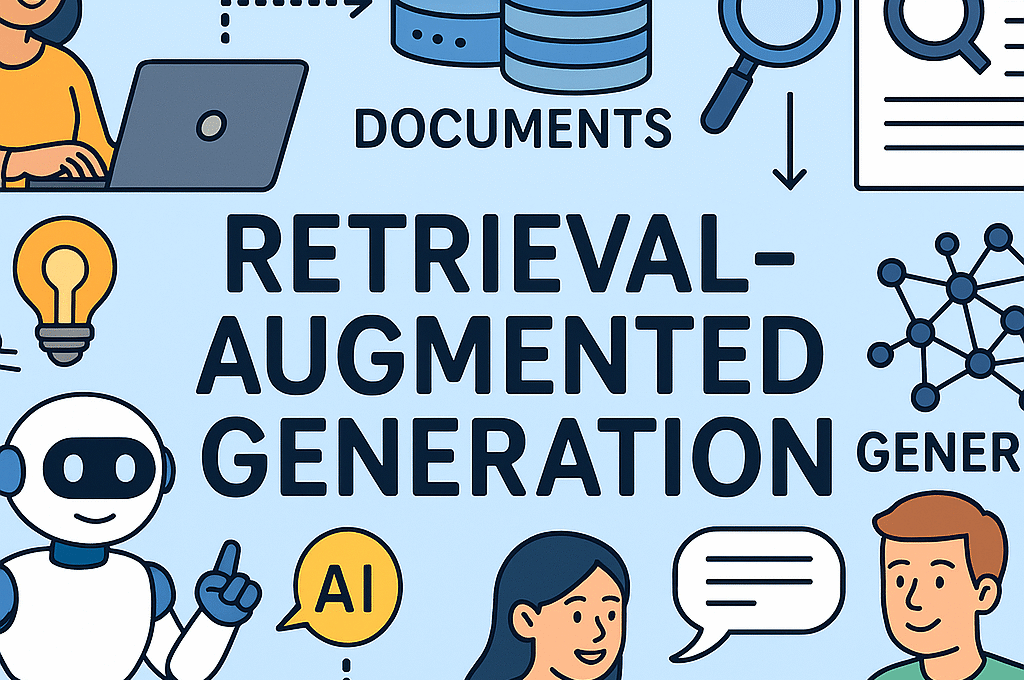
Imagine asking a friend a question, and instead of guessing, they quickly look up the answer in a trusted book before responding. That’s essentially what Retrieval-Augmented Generation (RAG) does for AI.
While large language models (LLMs) like ChatGPT are powerful, they have a key limitation: they only know what they were trained on. RAG fixes this by letting AI fetch real-time, relevant information before generating an answer—making responses more accurate, up-to-date, and trustworthy.
In this article, we’ll cover:
- What RAG is and how it works
- Why it’s better than traditional LLMs
- Real-world industry use cases (with examples)
- The future of RAG-powered AI
What Is RAG?
RAG stands for Retrieval-Augmented Generation, a hybrid AI approach that combines:
- Retrieval – Searches external databases/documents for relevant info.
- Generation – Uses an LLM (like GPT-4) to craft a natural-sounding answer.
How RAG Works (Step-by-Step)
1️⃣ User asks a question – “What’s the refund policy for Product X?”
2️⃣ AI searches a knowledge base – Looks up the latest policy docs, FAQs, or support articles.
3️⃣ LLM generates an answer – Combines retrieved data with its general knowledge to produce a clear, accurate response.
Without RAG: AI might guess or give outdated info.
With RAG: AI “checks its notes” before answering.
Why RAG Beats Traditional LLMs
| Limitation of LLMs | How RAG Solves It |
|---|---|
| Trained on old data (e.g., ChatGPT’s knowledge cuts off in 2023) | Pulls real-time or updated info from external sources |
| Can “hallucinate” (make up answers) | Grounds responses in verified documents |
| Generic answers (no access to private/internal data) | Can reference company files, research papers, or customer data |
Industry Use Cases & Examples
1. Customer Support (E-commerce, SaaS)
- Problem: Customers ask about policies, product specs, or troubleshooting—but FAQs change often.
- RAG Solution:
- AI fetches latest help docs, warranty info, or inventory status before answering.
- Example: A Shopify chatbot checks the 2024 return policy before confirming a refund.
2. Healthcare & Medical Assistance
- Problem: Doctors need latest research, but LLMs may cite outdated studies.
- RAG Solution:
- AI retrieves recent clinical trials, drug databases, or patient records (with permissions).
- Example: A doctor asks, “Best treatment for Condition Y in 2024?” → AI pulls latest NIH guidelines.
3. Legal & Compliance
- Problem: Laws change frequently—generic LLMs can’t keep up.
- RAG Solution:
- AI scans updated case law, contracts, or regulatory filings before advising.
- Example: A lawyer queries “New GDPR requirements for data storage?” → AI checks EU’s 2024 amendments.
4. Financial Services (Banking, Insurance)
- Problem: Customers ask about loan rates, claims processes, or stock trends—which fluctuate daily.
- RAG Solution:
- AI pulls real-time market data, policy updates, or transaction histories.
- Example: “What’s my credit card’s APR today?” → AI checks the bank’s live database.
5. Enterprise Knowledge Management
- Problem: Employees waste time searching internal wikis, Slack, or PDFs for answers.
- RAG Solution:
- AI indexes company docs, meeting notes, or engineering specs for instant Q&A.
- Example: “What’s the API endpoint for Project Z?” → AI retrieves the latest developer docs.
Tech Stack to Build a RAG Pipeline
- Vector Store: FAISS, Pinecone, Weaviate, Azure Cognitive Search
- Embeddings: OpenAI, Cohere, HuggingFace Transformers
- LLMs: OpenAI GPT, Anthropic Claude, Meta LLaMA, Mistral
- Frameworks: LangChain, LlamaIndex, Semantic Kernel
- Orchestration: Airflow, Prefect for production-ready RAG flows
The Future of RAG
RAG is evolving with:
- Multi-modal retrieval (searching images/videos, not just text).
- Self-improving systems (AI learns which sources are most reliable).
- Personalized RAG (pulling from your emails, calendars, or past chats).
Companies like Microsoft, Google, and IBM are already embedding RAG into Copilot, Gemini, and Watson—making AI less of a “bullshitter” and more of a trusted assistant.
Conclusion
RAG isn’t just a tech buzzword; it’s a game-changer for AI accuracy. By letting models “look things up” on the fly, businesses can:
✔ Reduce errors
✔ Improve customer trust
✔ Cut costs on manual research
Ready to implement RAG? Start by:
- Identifying key data sources (PDFs, APIs, databases).
- Choosing a RAG framework (LlamaIndex, LangChain, Azure AI Search).
- Testing with real user queries.